
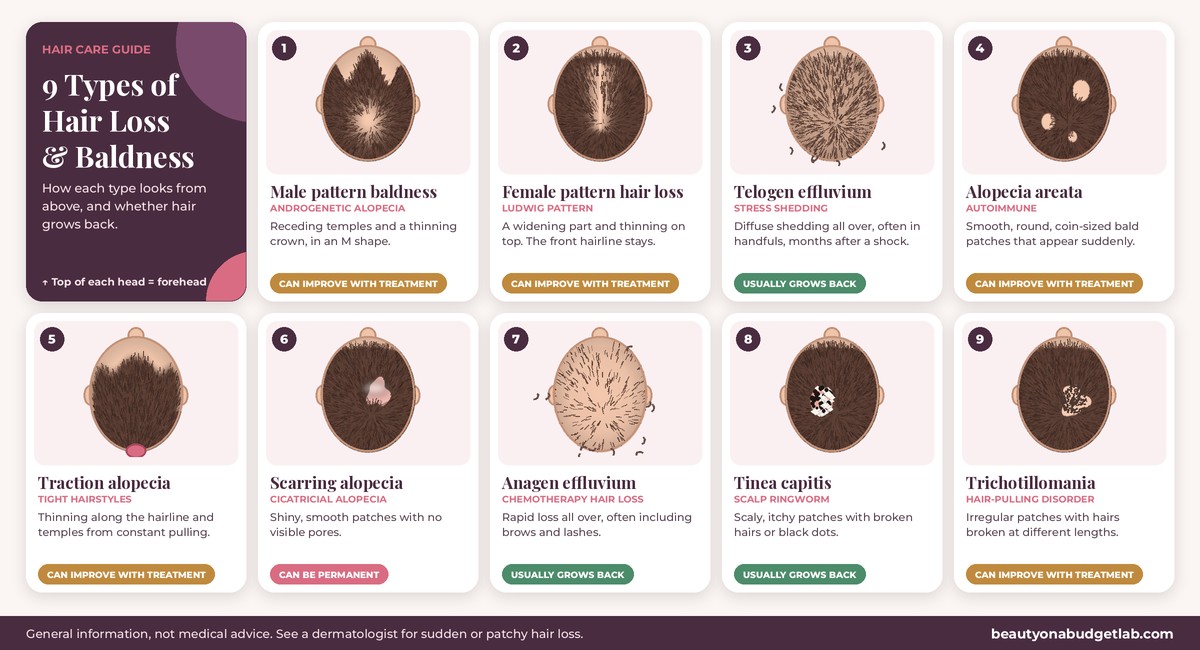
First, how much shedding is normal?
According to the American Academy of Dermatology, it’s normal to lose about 50 to 100 hairs a day. Every hair goes through a cycle of growing (anagen, which lasts years), a short transition, resting (telogen, a few months) and then shedding, after which a new hair grows from the same follicle. You may see more on wash days simply because loose hairs collect between washes. Hair loss becomes a problem when either far more hairs shed than usual, or follicles stop growing new hairs (or grow thinner ones). Each type below does one of those things.The 9 types of hair loss at a glance
| Type | Who it affects most | What it looks like | Can it grow back? |
|---|---|---|---|
| Male pattern baldness (androgenetic alopecia) | Men, often starting in the 20s or 30s | Receding temples and thinning crown (M-shape) | CAN IMPROVE WITH TREATMENT |
| Female pattern hair loss | Women, most often after menopause, but it can start in the 20s | A widening part and thinning over the top of the head | CAN IMPROVE WITH TREATMENT |
| Telogen effluvium (shedding after stress, illness or childbirth) | Anyone, after a shock to the body | Diffuse shedding all over, often in handfuls | USUALLY GROWS BACK |
| Alopecia areata | Anyone, any age, including children | Smooth, round, coin-sized bald patches | CAN IMPROVE WITH TREATMENT |
| Traction alopecia | People who wear tight hairstyles often | Thinning along the edges of the hairline and temples | CAN IMPROVE WITH TREATMENT |
| Scarring alopecia (cicatricial alopecia) | Less common; some types mostly affect women | Patches that look shiny and smooth, with no visible pores | CAN BE PERMANENT |
| Anagen effluvium (hair loss from chemotherapy) | People having chemotherapy or radiation to the head | Rapid hair loss all over, often including brows and lashes | USUALLY GROWS BACK |
| Tinea capitis (scalp ringworm) | Mostly children | Scaly, itchy patches with broken hairs or black dots | USUALLY GROWS BACK |
| Trichotillomania (hair-pulling disorder) | Often starts in the tween or teen years | Irregular patches with hairs broken at different lengths | CAN IMPROVE WITH TREATMENT |
The types of baldness, explained
1. Male pattern baldness (androgenetic alopecia)
CAN IMPROVE WITH TREATMENT This is the classic “going bald” that most people picture, and it’s by far the most common type. It’s driven by genes plus a hormone called DHT (dihydrotestosterone). In people who are genetically sensitive, DHT slowly shrinks hair follicles. Each new hair grows back a little thinner and shorter, until some follicles stop producing visible hair at all. It usually starts at the temples, the crown, or both, and doctors track it on the Norwood scale (stages 1 to 7). The American Academy of Dermatology estimates it affects about 50 million men in the US. Despite the old myth, the genes come from both sides of your family (we covered that in our hair regrowth myths article).How to spot it: Gradual thinning at the temples or crown, more scalp showing under bright light, and hairs that look finer than they used to.
Can it grow back? Shrunken follicles can be thickened again if you start early. Topical minoxidil is the over-the-counter starting point, and a doctor can prescribe finasteride or oral minoxidil. Follicles that have been inactive for years usually don’t come back, which is why starting early matters.2. Female pattern hair loss
CAN IMPROVE WITH TREATMENT This is the same genetic, hormone-sensitive process as male pattern baldness, but it looks different. Instead of a receding hairline, women usually keep their front hairline and notice a widening part or a ponytail that feels thinner. Doctors grade it on the Ludwig scale. The AAD estimates around 30 million women in the US have it. Hormone shifts matter here. Thinning often speeds up around menopause, and conditions like PCOS (polycystic ovary syndrome) can bring it on earlier.How to spot it: A part that looks wider than it did a few years ago, more scalp visible on top, and a thinner ponytail, with the hairline staying put.
Can it grow back? Yes, it often improves. 5% minoxidil foam is FDA-approved for women. A doctor may also check iron and thyroid levels and can prescribe options like spironolactone.3. Telogen effluvium (shedding after stress, illness or childbirth)
USUALLY GROWS BACK Normally about 10% of your hairs are in the resting (telogen) phase at any time. A big shock to your body can push many more hairs into that resting phase at once. About two to three months later, they all fall out together, which is why people rarely connect the shedding to the cause. Common triggers include a high fever or bad flu, surgery, giving birth, a crash diet, major emotional stress, stopping birth control pills, iron deficiency, thyroid problems and some medications. Postpartum shedding is so common that the AAD calls it normal; it usually peaks around four months after giving birth.How to spot it: Lots of hairs on your pillow, in the shower and in your brush, with a small white bulb at the root. The hair looks thinner all over rather than in one spot.
Can it grow back? Usually, yes. Once the trigger is gone, shedding typically slows within about six months and the hair grows back. If it lasts longer than six months, see a doctor to check for an ongoing cause like low iron or a thyroid problem.4. Alopecia areata
CAN IMPROVE WITH TREATMENT Alopecia areata is an autoimmune condition: the immune system mistakenly attacks hair follicles. It isn’t caused by anything you did, and it’s not contagious. It can run in families and is more common in people with other autoimmune conditions like thyroid disease or vitiligo. Most people get one or a few round patches. Less often it spreads to the whole scalp (alopecia totalis) or the whole body (alopecia universalis).How to spot it: Smooth, completely bald round patches that appear quickly, sometimes in the beard or eyebrows too. Some people notice tingling or itch first.
Can it grow back? Often. Small patches frequently regrow on their own within a year, though new patches can appear. A dermatologist can speed things up with steroid injections, and newer prescription pills called JAK inhibitors are FDA-approved for severe cases. Over-the-counter products are not a fix here.5. Traction alopecia
CAN IMPROVE WITH TREATMENT This type is caused by long-term pulling on the hair. Tight ponytails, buns, braids, cornrows, locs, weaves, extensions, and even tight helmets or headbands can all do it when worn for months or years. It’s very common, and very preventable.How to spot it: Thinning or a receding line right where the pull is strongest, usually the edges, temples and behind the ears. Small bumps or soreness after styling is an early warning sign.
Can it grow back? Yes, if you catch it early and loosen up. Switch to looser styles, rotate where the tension sits, and give your hair breaks between protective styles. If the pulling continues for years, the follicles can scar and the loss becomes permanent.6. Scarring alopecia (cicatricial alopecia)
CAN BE PERMANENT Scarring alopecias are a group of conditions where inflammation destroys the follicle and replaces it with scar tissue. Examples include frontal fibrosing alopecia (a slowly receding band at the front hairline, often in postmenopausal women), lichen planopilaris, and central centrifugal cicatricial alopecia (CCCA), which starts at the crown and is most common in Black women.How to spot it: Itching, burning, tenderness, redness or scaling around hairs, and patches where the skin looks shiny and the follicle openings have disappeared.
Can it grow back? Hair lost to scarring doesn’t grow back, but treatment can stop it from spreading. This is the type where seeing a dermatologist early matters most. A scalp biopsy is usually needed to confirm it.7. Anagen effluvium (hair loss from chemotherapy)
USUALLY GROWS BACK Some cancer treatments target fast-dividing cells, and hair follicles in their growing (anagen) phase are among the fastest. Hair can start falling out within days to a few weeks of starting treatment.How to spot it: Fast, widespread loss soon after starting chemotherapy. The hair often breaks off rather than shedding from the root.
Can it grow back? In most cases, yes. Hair usually starts growing back a few weeks to months after treatment ends, sometimes with a different texture or color at first. Ask your care team about scalp cooling, which can reduce hair loss with some chemotherapy drugs.8. Tinea capitis (scalp ringworm)
USUALLY GROWS BACK Despite the name, ringworm is a fungal infection, not a worm. On the scalp it causes patchy hair loss and is contagious through shared combs, hats, pillows and close contact.How to spot it: Round, scaly or flaky patches, hairs broken off near the scalp (sometimes leaving little black dots), and sometimes swollen, tender bumps.
Can it grow back? Yes, once it’s treated. It needs a doctor’s diagnosis and oral antifungal medicine, because creams and shampoos can’t reach deep enough into the follicle on their own. Medicated shampoo is often added to stop it spreading to others. Left untreated, severe cases can scar.9. Trichotillomania (hair-pulling disorder)
CAN IMPROVE WITH TREATMENT Trichotillomania is a body-focused repetitive behavior where people feel a strong urge to pull out their own hair, often without fully noticing. It can affect the scalp, eyebrows or eyelashes. It’s more common than most people realize and has nothing to do with willpower.How to spot it: Oddly shaped patches with hairs of many different lengths, often on the side of the dominant hand.
Can it grow back? Yes, if the pulling stops before the follicles are damaged. The most effective treatment is a type of behavioral therapy called habit reversal training, so talking to a doctor or therapist is the best first step.Other common causes worth checking
Some hair loss is a symptom of something else going on in the body. These causes usually show up as telogen effluvium (diffuse shedding) or make pattern hair loss worse:- Low iron or ferritin: especially common in people with heavy periods or plant-based diets.
- Thyroid problems: both an underactive and an overactive thyroid can cause thinning.
- Hormone conditions: PCOS can cause scalp thinning along with acne or extra facial hair.
- Medications: some blood thinners, acne retinoids, blood pressure drugs, antidepressants and others list hair loss as a side effect. Never stop a prescription on your own; ask your doctor about alternatives.
- Big diet changes: rapid weight loss or too little protein can trigger shedding a few months later.
- Hair breakage: not true hair loss at all. Heat styling, bleach and rough brushing snap hairs mid-shaft, which can look like thinning. A good heat protectant helps here.
Shopping for a gentler wash day? Our list of the best drugstore shampoos for thinning hair covers ketoconazole, caffeine and volumizing options.
When to see a doctor
Gradual pattern thinning is fine to start treating at home. See a doctor or dermatologist if you notice any of these:- Round bald patches, or hair coming out in clumps
- Redness, scaling, pus, burning, pain or itching on the scalp
- Shiny, smooth patches where the pores seem to have disappeared
- Heavy shedding that lasts more than six months
- Hair loss along with tiredness, weight changes, irregular periods, acne or new facial hair
- Hair loss in a child, or after starting a new medication